

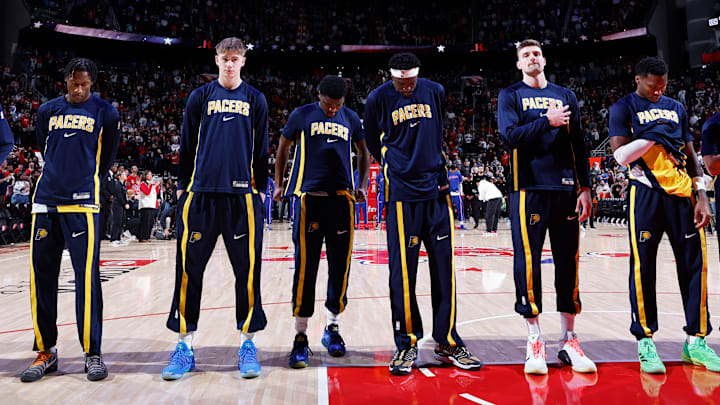
Believe it or not, 2025 averages out to one of the most average calendar years in Indiana Pacers history.
It’s truly been a tale of two half-years. The first six months of 2025 featured the highs of a stellar finish to the regular season and an epic postseason run all the way to Game 7 of the NBA Finals.
The second half of the calendar year included the lows of a league-worst record to start the 2025-26 season and the rash of injuries to key players.
It’s all added up to a decidedly average 40-41 Indiana record in regular season games this calendar year – 34-14 after Jan. 1 to finish the 2024-25 season and 6-27 to start the 2025-26 season, with one game to go in 2025.
Ring in the New Year with a look at the Pacer calendar years that were the best, the worst, the busiest, and the most surprising in franchise history.
Best calendar year: 1969
Indiana went 56-20 during the 1969 calendar year – a 29-15 flurry to finish the 1968-1969 season and then a 27-5 start to the 1969-70 campaign. The strong closing kick after Jan. 1 in 1968-69 resulted in the Pacers’ first division title and first ABA Finals appearance. The stellar start through Dec. 31 of the following season was the opening flex for a team that went on to win Indiana’s first ABA title.
Runner-up: Indiana was 39-14 during the 1998 calendar year, a winning percentage (.736) just a fraction behind 1969 (.737). That 1998 stretch was the second half of Larry Bird’s first season as Pacers coach, the year Indiana pushed the “Last Dance” Chicago Bulls to seven games in the Eastern Conference Finals. Those 53 games are all the Pacers played during the 1998 calendar year. The start of the following season was pushed to February 1999 due to a lockout.
Worst calendar year: 1983
Indiana posted a brutal 16-65 record during the 1983 calendar year – a disastrous 9-44 record after Jan. 1 during the 1982-83 season, followed by a 7-21 record to start the 1983-84 schedule.
Runner-up: The Pacers’ second-worst calendar year was 1985, a 23-59 stretch that looks great compared to 1983.
(Pacer fans old enough to remember the 1980s won’t be surprised to learn six of the eight worst calendar years in franchise history occurred between 1982 and 1988.)
Surprisingly good calendar year: 2018
The balanced and overachieving Indiana squad built around Victor Oladipo in the late 2010s went 54-28 during the 2018 calendar year, 29-16 to finish the 2017-18 season, followed by a 25-12 start to 2018-19. The .659 winning percentage in 2018 is tied for the seventh-best calendar year in franchise history. That’s better than, for example, 1970, which encompassed an ABA title season in 1969-70 and the start of a league-best regular season in 1970-71.
Indiana fans know the good vibes in 2018 didn’t last. Oladipo suffered a severe quadriceps injury early in 2019, and things were never quite the same for that Pacer squad.
Surprisingly average calendar year: 1974
Indiana reached the ABA Western Division finals in 1973-74. The Pacers made their fifth trip to the ABA Finals in 1974-75. Yet during the 1974 calendar year, those seasons had in common that Indiana posted a record of just 39-38.
The Pacers were 25-20 after New Year’s Day in 1973-74, which constituted a slump for a team that was a two-time defending ABA champion. Indiana, perhaps understandably, was 14-18 through Dec. 31 in 1974-75, as the Pacers were adjusting to the offseason departures of franchise legends Mel Daniels and Freddie Lewis.
Busiest calendar year: 2021
Indiana played a whopping 103 regular-season games during the 2021 calendar year as the NBA worked its way back to the traditional 82-game schedule following the COVID-disrupted 2019-20 and 2020-21 seasons. The Pacers went 44-59 over that stretch – a 35-win pace for an 82-game schedule - much of it coinciding with Nate Bjorkgren’s one-season tenure as Indiana's coach.
Indiana also had an overloaded schedule during the 2012 calendar year. The Pacers played 93 regular-season games in the aftermath of a lockout that delayed the start of the 2011-12 campaign. Indiana went 57-36 during the 2012 calendar year – a 50-win pace over 82 games. This stretch encompassed a breakthrough 2011-12 season that featured the team’s first playoff series victory in seven years, plus the first games of a 2012-13 campaign that saw the Pacers extend the “Big Three” Miami Heat to seven games in the Eastern Conference Finals.
At the other extreme, Indiana played just 44 games during the 2020 calendar year due to the COVID shutdown. The Pacers played just 53 and 55 games in 2011 and 1998, respectively, due to labor stoppages. And Indiana played just 38 games in 1967, but there’s a good reason – it was the first half of the first season in franchise history.
Indiana Pacers records by calendar year
Year W L %
1969 56 20 0.737
1998 39 14 0.736
2013 56 24 0.700
2004 53 24 0.688
1971 59 28 0.678
1999 53 26 0.671
2018 54 28 0.659
1994 54 28 0.659
2020 27 17 0.614
2012 57 36 0.613
1970 54 35 0.607
1996 50 33 0.602
1995 50 33 0.602
1973 51 34 0.600
1975 50 34 0.595
2002 47 33 0.588
2000 49 35 0.583
2003 48 36 0.571
2019 45 34 0.570
1967 21 17 0.553
1972 45 37 0.549
2001 46 38 0.548
2015 44 37 0.543
2005 44 37 0.543
1997 45 38 0.542
2024 46 39 0.541
1981 39 34 0.534
2017 45 40 0.529
1979 44 41 0.518
1992 41 39 0.513
2016 43 41 0.512
1974 39 38 0.506
1987 40 39 0.506
1991 42 41 0.506
1989 42 41 0.506
2014 43 42 0.506
2006 43 44 0.494
1980 41 42 0.494
1993 38 42 0.475
2011 26 29 0.473
2010 37 45 0.451
1977 34 43 0.442
1968 32 42 0.432
2021 44 59 0.427
2009 35 47 0.427
2023 32 44 0.421
1990 34 49 0.410
1976 36 52 0.409
2007 33 49 0.402
2008 31 50 0.383
1986 31 50 0.383
2022 31 52 0.373
1982 30 51 0.370
1988 30 53 0.361
1978 28 58 0.326
1984 27 57 0.321
1985 23 59 0.280
1983 16 65 0.198
 Add us as a preferred source on Google