

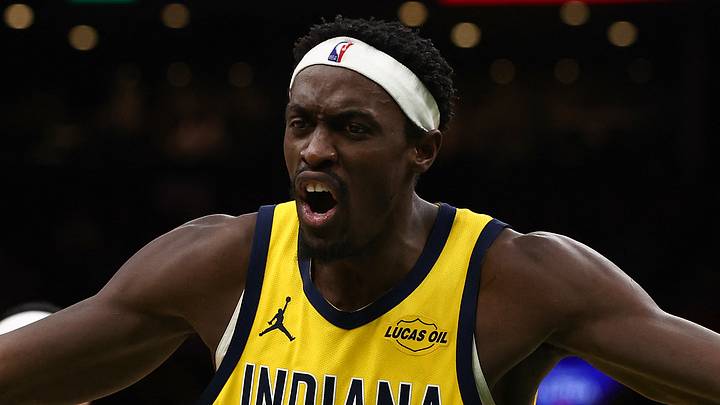
There was a post that went viral about the Indiana Pacers on social media today. A fan took aim at Pascal Siakam and his defensive playmaking in what can only be described as a graphic that looked straight out of Homer Simpson's insane asylum breakdown that somehow still had real, interesting basketball information hidden within it.
Within this deep dive, the poster made two major arguments about Siakam's game. The first and more justifiable take was that the Pacers forward's newfound inability to make his free throws makes his increased attempt count at the line far less useful than it could be.
This is an idea that makes some sense. Siakam dropped his efficiency on foul shots by 4% to the lowest level it has been since he was a sophomore averaging seven points per game. Even though he has increased his volume to six FTA per game, he is still leaving two points on the floor per contest.
However, the other take, which claimed that Siakam is A) an awful defender and B) not a suitable number two option because of his limited ability to scale his role up, fully takes the idea of analytics too far.
Sometimes numbers lie
I am a fan of analytics. It has cut through the noise of aesthetics in a fandom that was increasingly obsessed with them. It prevented the Pacers from becoming a "that boy is nice" team when Caris LeVert was increasingly stinking up the court while looking like a capable creator.
There's a reason that analytics love the best players in the league. The numbers should favor good players because, you know, good players are usually good.
However, analytics – and I know, it's a buzzword we've overused – are also susceptible to many of the same issues as blind film study.
Let's use Siakam as an example here.
Pascal and Tyrese Haliburton were +12 (approximately) when sharing the court together during the team's magical run to the NBA Finals. When Haliburton sat, Siakam failed to take the rest of the lineup to a positive net rating (again, approximately).
What this tells us is that Siakam struggles to shoulder the offensive load on his own without someone enabling his scoring. For a player making 30% of the cap, that's a pretty damning blind spot. However, the truth is different.
It is so much more important for a #2 option to scale down alongside another star than it is for them to take over the game and ascend to the role of a pseudo-#1 for 12 minutes per game.
Siakam is excellent at working off Haliburton. That is far more important than what he does without him. They'll be sharing the court for over 30 minutes per game anyway. That's basically 75% of the game.
The entire roster is built on this scalability principle. What can you do with less? Prove that before you earn more.
Look around at the Pacers, specifically at Siakam and Andrew Nembhard, a second-round pick whose fit with Tyrese Haliburton has turned him into a star in his own right, and understand that this is a feature, not a bug.
 Add us as a preferred source on Google