

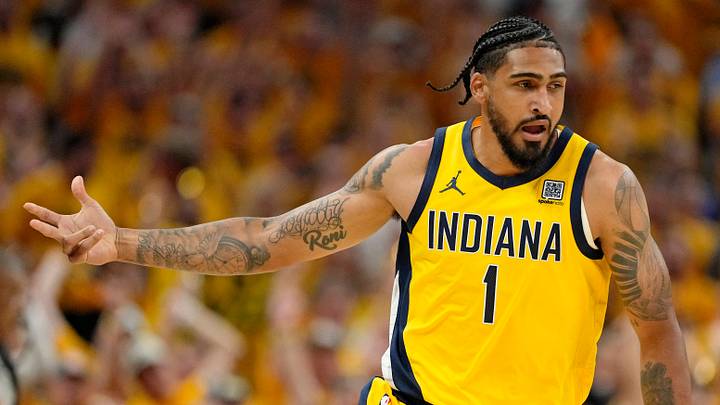
So often in the NBA, stars are highlighted for their top skills. No one is shocked by Steph Curry's show of shooting anymore, nor do people doubt Giannis Antetokounmpo's ability to get to the rim, or LeBron James' basketball IQ.
However, within that conversation, we lose track of the supplementary skills that make players so much more than just the sum of their parts. In this series, we will take a deeper look at those secondary talents that certain Indiana Pacers leverage to maximize themselves.
These skills can be on-court ones or mental states that differentiate certain Pacers from their cross-league counterparts. The focal player of the last piece in this continued series was TJ McConnell, who takes being the David in a league of Goliaths to an extreme, surviving as a 6'0 flat player until his age-34 season.
This one will center on Obi Toppin, whose biggest strength – his versatility – may also be preventing a breakout.
Obi Toppin ended up in an Indiana Pacers jersey in a very strange, roundabout way. Entering the 2020 draft, the Pacers had no first-round pick, having traded it to the Milwaukee Bucks as part of a sign-and-trade deal for Malcolm Brogdon.
The Pacers at the time were a middling franchise in the East, led by Victor Oladipo and Myles Turner. After Oladipo's breakout in 2018, the Pacers had failed to take a step forward, instead finishing with the fifth and fourth seed and losing both of their first round serieses.
While the Pacers were on a downturn, Toppin was on top of the world.
Before going eighth overall, Toppin was (or would've been) the presumptive player of the year despite a suspended season due to COVID. Even more shockingly, he did so at Dayton of all schools.
A few years down the road, the two graphs had flipped completely. The Indiana Pacers were trending upwards while Toppin's career had fizzled.
Indiana had traded for Tyrese Haliburton in what has rapidly become a more and more one-sided deal, and had rebuilt their identity after the Oladipo era came to a crushing end. With more spacing and sprinting involved, they had become darlings of the league, with a young point guard to guide them.
Obi went to the New York Knicks on draft night. For the first time in two decades, going to the Knicks seemed to be a good thing. Presumed to be part of the planned fast-break-focused offensive revolution, Toppin instead found himself in a Tom Thibodeau system that neutered him of his biggest strengths.
So, when Toppin arrived in Indiana, he was either going to excel or see his once-promising career die.
He chose the latter.
From Game 1, he rebounded better than he ever had in New York. He defended better in a system, giving fans fewer highlight plays but far better impact on a game-to-game basis. He became an ideal role player. Not the star he once hoped he could be, but instead the player who he needed to be.
However, maybe there's some space to bring that back. That transition was what kept Toppin in the league, but it is also what has kept him stagnant. Now, with Indiana pushing for a title, maybe it's time for Obi's biggest strength to change.
In the career of a versatile but sporadic forward, becoming consistent was a way to save himself. Becoming the creator and attacker he was in college would let him save the Pacers.
 Add us as a preferred source on Google