

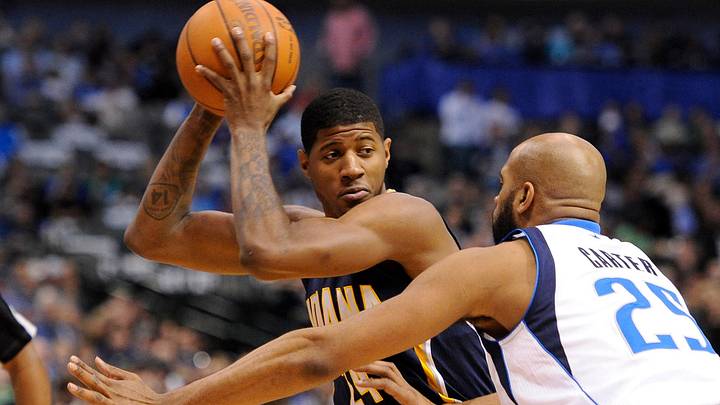
Indiana fans typically greet Paul George with boos whenever the former Pacer All-Star visits Gainbridge Fieldhouse.
Cheers and a hearty thank you might be the more appropriate reaction when George returns to Indiana for his first appearance in the uniform of his new team, the Boston Celtics, on March 2.
With almost a decade of hindsight, it’s clear the “trade tree” that resulted from the Pacers’ trade of George to the Oklahoma City Thunder back in 2017 is the most bountiful in the franchise’s history. All told, the presence of seven players on the current Indiana roster – including several key players from the Pacers’ 2025 NBA Finals run - can be traced to that deal.
Here’s a look at the five most bountiful trade trees in Pacer history.
#5 - The Al Harrington tree
Indiana’s first draft pick on a player directly out of high school eventually yielded a starting lineup worth of players.
Pacers draft Harrington: Indiana selected Harrington with the No. 25 pick in the 1998 NBA Draft. Harrington developed into a solid contributor for the young Indiana teams in the early 2000s, finishing runner-up in the 2004 Sixth Man of the Year voting.
Traded for Jack: Harrington was moved to Atlanta in the summer of 2004 in exchange for Stephen Jackson, a small forward who was seen as the missing piece to a championship puzzle for a Pacer team that reached the Eastern Conference Finals the previous year.
Post-brawl rebuilding: Jackson, a re-acquired Harrington and others were sent to the Golden State Warriors in 2007 as Indiana looked to re-construct its roster in the aftermath of the franchise-altering 2004 brawl in Detroit. The Pacers received four players in return. Two of them - Mike Dunleavy and Troy Murphy – were regulars during their time in Indiana.
Collison comes to Indiana: This trade tree splintered in the late 2000s, but did yield one more solid contributor. The Pacers gave up Murphy in 2010 as part of a four-team deal that brought point guard Darren Collison to Indiana. Collison helped the Pacers end a five-year playoff drought in 2011 and win a playoff series the following year.
#4 - The Herb Williams tree
The selection of Herb Williams, a big man from Ohio State, yielded a big return for Indiana over the years
Pacers draft Williams: Indiana drafted Williams with the 14th pick in the 1981 NBA Draft. Williams was a reliable starter for the Pacers for most of the 1980s.
Deal with Dallas for Schrempf and more: In one of the best trades in Indiana’s NBA history, the Pacers sent a 31-year-old Williams to the Dallas Mavericks in return for Detlef Schrempf and a second-round pick in 1989. Schrempf was an All-Star and a two-time Sixth Man of the Year for the Pacers. The draft pick wound up being Antonio Davis, a frontcourt standout for Indiana’s strong teams in the 1990s.
McKey was a key: The Pacers traded Schrempf to the Seattle Supersonics in exchange for Derrick McKey (and Gerald Paddio) on the eve of the 1993-94 season. The move was panned at the time, but McKey’s arrival coincided with Indiana’s NBA postseason breakthrough that season – the first of five trips to the Eastern Conference Finals in seven years.
What could have been: A good trade tree could have been an epic one had the Pacers’ trade of Davis for Jonathan Bender in 1999 played out as Indiana envisioned. Bender was the top high school player selected in the 1999 draft. The Pacers had to like their odds in the transaction - the top high school players in the four previous drafts were Kevin Garnett, Kobe Bryant, Tracy McGrady and Harrington – but for a variety of reasons, Bender never reached that level.
#3 - The Dale Davis tree
Indiana’s selection of Dale Davis with the 13th pick of the 1991 NBA Draft led to a quarter-century of productive frontcourt play for the Pacers.
Pacers draft Davis: Davis was the starting power forward for all five of Indiana’s Eastern Conference Finals teams in the 1990s. He was rewarded with an All-Star appearance in 2000.
Davis swapped for O’Neal: The Pacers traded the 31-year-old Davis for a 21-year-old Jermaine O’Neal before the 2000-01 season. O’Neal developed into a six-time All-Star and finished third in the 2004 MVP voting as the Pacers posted the best record in the NBA.
O’Neal deal yields Hibbert: O’Neal’s time in Indiana ran its course by the end of the 2007-08 season. The Pacers sent O’Neal and another player to Toronto in return for four players, including Roy Hibbert, the No. 17 pick in that summer’s NBA Draft. Hibbert developed into a two-time All-Star and the Defensive Player of the Year runner-up in 2014, when Indiana had the best record in the Eastern Conference.
#2 - The Chuck Person tree
You could make a strong case for this trade tree as the most fruitful in Indiana history.
Pacers draft Person: The Pacers drafted Person out of Auburn in 1986. Person won Rookie of the Year honors in his first season in Indiana and led the Pacers in scoring in each of his first three seasons.
Two trades lead to Jackson: Indiana traded Person to the Minnesota Timberwolves in the fall of 1992. Pooh Richardson was one of the players the Pacers received in return. Two years later, Indiana sent Richardson and two other players to the Los Angeles Clippers in exchange for Mark Jackson, who became the Pacers’ starting point guard for most of the decade.
Jackson trade haul results in Rose, Mullin: Jackson’s Indiana career was briefly interrupted when he was traded to the Denver Nuggets prior to the 1996-97 season. (Jackson was re-acquired in a separate deal the same season). Indiana got Jalen Rose and a first-round draft pick in the Jackson deal. Rose became the leading scorer on Indiana’s 2000 NBA Finals team. The Pacers used that draft pick on Erick Dampier, who was later dealt to the Golden State Warriors as part of the package that sent Chris Mullin to Indiana, where he played a key role in three consecutive Eastern Conference Finals trips.
Rose dealt for Miller, Artest: Rose and others went to the Chicago Bulls during the 2001-02 season in exchange for four players, most notably Brad Miller and Ron Artest (now Metta World Peace). Miller was an All-Star in his lone full season in Indiana. Artest was an All-Star and Defensive Player of the Year in 2003-04 as the Pacers won 61 games.
Stojakovic’s brief Indiana stop: Artest’s Indiana career was derailed by the infamous brawl in Detroit. That led to the last notable deal on this tree. Indiana sent Artest to the Sacramento Kings in 2006 in exchange for a half-season of Peja Stojakovic.
#1 - The Paul George tree
When a trade tree yields three of the five starters on an NBA Finals team and four total All-Stars, it’s the best trade tree in your franchise’s history
Pacers draft George: The selection of George with the No. 10 pick in the 2010 NBA Draft by itself was one of the best moves in franchise history. George was a four-time All-Star in Indiana and the best player on the Pacer teams that reached the Eastern Conference Finals in 2013 and 2014.
OKC swap turned out OK: George requested a trade out of Indiana during the summer of 2017. The Pacers obliged, sending Geroge to the Oklahoma City Thunder in exchange for recent OKC draft picks Victor Oladipo and Domantas Sabonis. Oladipo and Sabonis both blossomed into All-Stars in Indiana and helped the Pacers make three more playoff appearances.
Oladipo equals other key players: Oladipo sustained a serious quadriceps injury midway through his second season in Indiana and never regained his All-Star form. The Pacers traded Oladipo to Houston as part of a four-team deal in 2021. The side effects of that deal eventually brought Pascal Siakam, Andrew Nembhard, Ben Sheppard and, most recently, Ivica Zubac to Indiana.
The King of all deals: The most important branch of this trade tree was the swap that sent Sabonis and others to Sacramento in exchange for Tyrese Haliburton and others. Haliburton of course emerged as the engine that drove Indiana’s run to the 2024 Eastern Conference Finals and the 2025 NBA Finals.
Paul George - The GOAT of trade value?
George might be the most valuable player in NBA history, if measured by trade value brought in return.
The assets the Pacers received from trading George to Oklahoma City pale in comparison to the haul the Thunder accumulated – highlighted by two-time MVP Shai Gilgeous-Alexander - when they sent George to the Los Angeles Clippers in 2019.
Even slightly past his prime, George was able to command a recent NBA Finals MVP - Jaylen Brown - as the asking price when he was traded from the Philadelphia 76ers to the Boston Celtics this summer.
 Add us as a preferred source on Google